Der Schmale – David Lenaerts’s blog

Flash Platform Experiments

Return of the ripples! Shallow water simulation with Pixel Bender.

Tags: , , , , , , , ,

shallowwater

When looking at my blog stats, the most popular post by far is the old Ripple effect I did some time ago, which was based on an old demoscene trick. For a while, I’ve wanted to do a more physically correct version based on shallow water equations. Since the watercolour effect I did was based on a similar variation (as well as the image bleeding in the previous post), I decided to throw together a quick test to see if it could be turned into a new iteration of the old ripple effect. It’s mainly done for sake of experimentation, and if you really want a ripple effect I suggest using the prior one. Although the dynamics are more interesting, this one is slower, but I’m pretty happy with the performance considering the amount of calculations and the grid size (the demo has a grid of 200×200).

  • Demo
  • Source – There’s a few parameters to play around with, but take care: the simulation might just blow up with extreme settings ;)

Some day I might try out a sim with the real shallow water equations, just in case you haven’t gotten violently sick from all the fluid simulations lately (I haven’t, as seems) :D

Leave a comment (37 comments)

Image bleeding with water (Flash + PixelBender)

Tags: , , , , , , ,

Image BleedingThe last 2 months, I’ve been investing 99% of my free time into the next iteration of Farbe, turning it into a real Flex-based image editing tool simulating natural media. Although there’s nothing of the application itself that I can show yet, today I created another small proof of concept for it that I can make public.

One of the things lacking in the watercolour POC was that once a brush stroke was made, nothing could be done with it. I thought it’d be nice to still be able to add water once the paint was rendered and have the colours bleed out. Using much of the same physics as for the watercolours, I figured out an algorithm that was both adequate in speed (real-time) as visually effective enough to water down the image. As usual, much Pixel Bender was used. The multi-threaded nature of ShaderJob really proved its worth in this case. You can keep adding water without the simulation slowing down the interaction, even if the simulation itself gets slow when there’s a lot of wet areas to cover.

To get the most realistic results, settings such as “ink speed” and “water amount” should be kept low while slowly rubbing over the image. Higher levels are not natural and will look caricatural (reminding me of Kai’s Power Tools of old! ;) ).

So check it out! :)

Note that, even tho Farbe is not an open source project (or not yet at least), I’m providing the source for this POC – consider it a late Easter present ;) But do remember, it IS poc-style code!

In closing, I’ll leave you with a few updates on Farbe. First of all, the watercolour paint is quite a bit faster (unless, of course, you’re working on much bigger canvas sizes than the cheaply upscaled old version) and so far it seems it’s pretty bug free! Secondly, I recently finished a pencil and eraser tool which are looking alright. The rest of the time has been spent mainly on the user interface and typical paint tool functionality. I’m starting to feel quite overworked at the moment, but the app is shaping up so it’s worth it! I hope I’ll be able to give out some more tangible updates on all that soon :)

Leave a comment (8 comments)

Strange visual results, pseudo generative art?

Tags: , , , ,

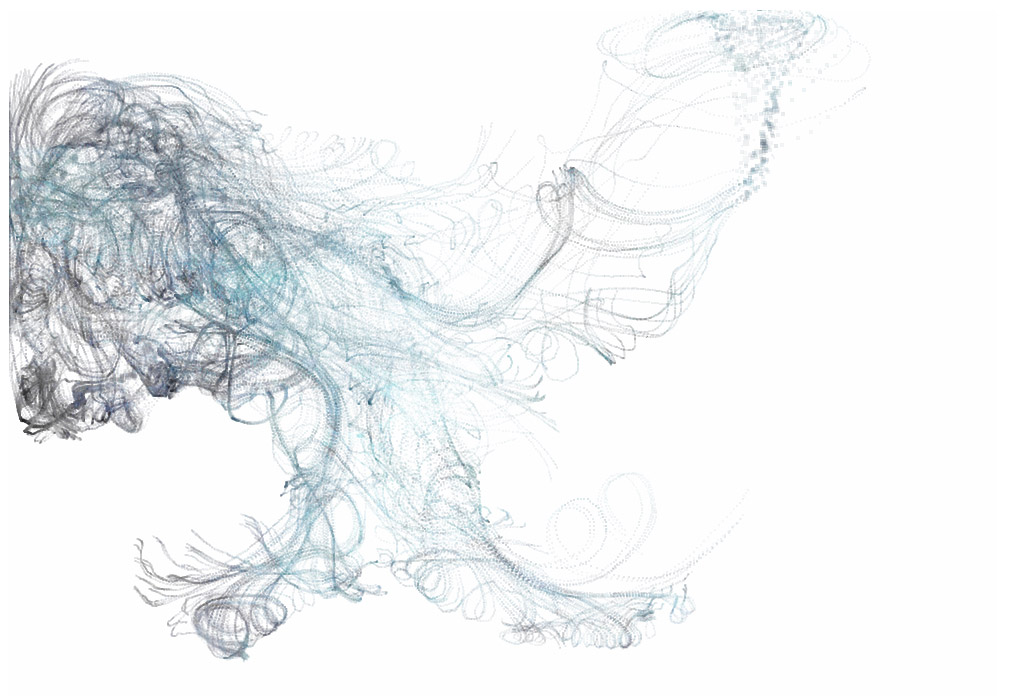
Last night, I had the idea to take part of the previous fluid solver, but instead of placing the “ink” in a grid, I’d replace it with particles and have those move according to the velocity grid. It would give a stronger impression of detail.

It didn’t look all that great from a realistic point of view, but I discovered that when I added permanent trails, things started to look more interesting, even tho I was moving further and further away from my initial idea. After some more experimentation, the result is some interesting pseudo-art (“pseudo” since I’m not an artist, and never will be ;) ).

I like how some of them turned out, but that’s coming from a guy who likes to look at pictures of strange attractors and spends too much time staring at his cigaret smoke :D

All of these were generated in Flash using Alchemy.


Leave a comment (11 comments)

Experimenting with Alchemy: of Smoke, Milk, and Ink

Tags: , , , , , ,

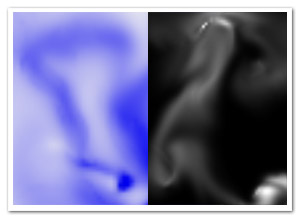
Smoke and Milk simulationThanks to Ralph Hauwert’s blogpost pushing a baffling >300.000 particles using Alchemy, I finally got the much needed motivation to try out Alchemy myself. To be able to get started asap, I decided to return to something I’ve done before: fluid and smoke dynamics, but with a different algorithm (see Mike West’s article on Gamedev). It took me a while to figure it out, but it’s up an running! It’s a faster algorithm, but less physically correct.

While I typically would do most of these kinds of calculations in Pixel Bender, for the examples below, I decided to try it all in C and see how far Alchemy can be pushed. The grid is bigger than before, while the framerate is steady around 20 on my machine. Ralph has suggested some improvements for the rendering step already (thx! ;) ), so I’ll have some more experimenting to do :D

It was great to return to C, especially since it’s been 8 years since I’ve written my last line in that language. Quite a rush of nostalgia!

Source is included with the demos, tho it’s not the most reusable I’ve ever written :)

The HiRes FPS counter is done by Mr. Doob.

Leave a comment (18 comments)

Flash watercolour simulation (using PixelBender)

Tags: , , , , , , , , , ,

farbe-watercolour

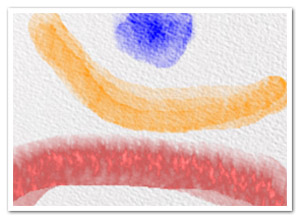
Something I’ve been thinking about doing for a long time is imitating real artistic media, in particular watercolours. Not because I’m an avid watercolour painter (last time I’ve touched them was in kindergarten), but because I think it’s an interesting dynamic. Since it is mainly fluid dynamics, the idea resurfaced after my previous fluid sims. And luckily, with Pixel Bender, I can finally do this kind of thing! This paper by Cassidy J. Curtis et al was great, tho it also caused me to loose some time figuring out some errors. Finally I came up with something, dubbed Farbe (simply German for ‘colour’). One thing I dropped was the interaction between different strokes, because that would kill the cpu easily enough.

For a change, there’s no source of this, and for a few reasons. First of all, it’s a mess and needs to be optimized. Apart from that, I might just add on to this before I release anything (hence the project name ‘Farbe’).

The picture on the left is my poor imitation of Joan Miró’s Barcelona ’92 poster (Strepie, this one’s for you ;) ), so ignore that and create your own :)

See Farbe in action

Leave a comment (25 comments)

© 2009 Der Schmale – David Lenaerts’s blog. All Rights Reserved.

This blog is powered by Wordpress and Magatheme by Bryan Helmig.