Der Schmale – David Lenaerts’s blog

Flash Platform Experiments

BSP/PVS released in Away 3.5.0!

Tags: , , , , , , ,

bsppvsToday, we’re happy to announce the release of Away3D 2.5.0 and 3.5.0. Along with other features and changes, of which you can read more in the official announcement, it contains the new BSP/PVS support! I’ve slaved months on this, so I’m glad it’s finally made public! Keep in mind that we’re always improving it, so it’ll only get better from here :-) So what’re all these abbreviations about?

(Warning: a long-winded post ahead. If you’re not interested in the details, stick to the official announcement!)

Binary Space Partitioning

BSP is a scene graph that divides a static scene up by splitting it recursively along planes into two half-spaces. If after splitting, the geometry in that subspace is convex, no further subdivisions are needed. In the end, we have a binary tree containing convex meshes at the leaves. What’s the use, you may ask? Well, since all the parts are convex, we don’t need to do any per-triangle sorting. By correctly traversing the tree and rendering the parts in the right order, the sorting is faster AND 100% correct. Specifically for Flash 3D, that means we don’t need to subdivide triangles to try and resolve z-fighting. Furthermore, it also greatly speeds up frustum culling and collision detection. This only works for static scenes however. There are dynamic bsp trees, but they don’t support the biggest speed-up, being the PVS.

Binary Space Partitioning on Wikipedia

The Potentially Visible Set

bsppvs2When we have a static BSP, we can use this data to determine which leaf nodes are visible from any given leaf node. This dataset is called the PVS (Potentially Visible Set). It allows us to prevent most of the occluded geometry from being rendered (which, usually, is most of the total geometry). Needless to say, this can lead to huge speed improvements. It’s the same technique games such as Quake, Half-Life, Unreal, … used. However, this speed improvement comes at a price (or what did you think? :) ), which is explained in the “Building” section of this post.

This little bastard was a pain to do. It’s the reason days turned to months of my evenings to get right, and I definitely couldn’t have done it without the help from this thesis: View Space Linking, Solid Node Compression and Binary Space Partitioning for Visibility Determination in 3D Walk-Throughs by Joel Anderson. Also, props to Joa for giving me some optimization tricks and food for thought!

Potentially Visible Set on Wikipedia

Building

Fabrice did a great job implementing the BSP/PVS builder into Prefab3D, so you can bake your lighting and generate the BSP/PVS as AWData in one programme. When compiling a model with PVS, there’s some guidelines you should keep in mind. No, let’s call them rules instead. Not obeying these could result in the build getting stuck, poor collision detection, or some random unpredictable results.

  • bsppvs3Your model must be completely “sealed”. No leaks into “nothingness”! This is important because the PVS would try to find visible data from that leak and get stuck.
  • Work on a grid. Make sure your vertices are snapped to a grid which is not too coarse. If not, the BSP splitting could create triangles that are too small, causing havoc in the form of floating point errors, too small triangles, inefficient splits, etc…
  • Try to occlude a lot. Don’t make too much geometry visible from any part of the model. This speeds up the model during rendering as well as the PVS build.
  • Axis-aligned walls/ceilings/floors work best. They’re fast to do calculations on and if you model somewhat smartly, they form a better “space splitter”.
  • Sometimes it’s good to keep small details out of the BSP geometry, and add them using the regular addChild method as this keeps the trees cleaner and more efficient.

Finally, there’s a LOT of settings, but you should probably not have to mess too much with them unless you really know what you’re doing. Soon, we’ll have some proper tutorials explaining the nitty-gritty of building (and we might have some other tools to make things easier on you).

Check the video showing a build in action!

Demos

  • The Hacienda Experiment (Beta): Fabrice and I created this for Adobe’s keynote at FITC Amsterdam in a very limited amount of time, before the BSP functionality was even finished. Lots of stress and insecurities, building the AWData exporter, etc. So, forgive us if there’s still some bugs in this version ;-) (If you get stuck, jumping out using the space bar usually does the trick ;-) )
  • Bunker Demo: Made by Fabrice to illustrate how easy it is to export BSP/PVS data from Prefab3D (see video mentioned before). It also shows how fast it can run with good occlusion. (Check the source)

Thanks for sticking around for such a long post, but hey, with the amount of work gone into this, I reserve the right to bore you to death with it! ;-)

Leave a comment (17 comments)

Fresnel reflective shading with Away3D

Tags: , , , , , , , , ,

fresnel-awayFinally, something new! But no, it’s not any of the bigger things I’ve been hinting at before. However, I’ve been hard at work at those (and other) projects for months, and ended up with tunnel vision and an annoying rut. I really needed to do something smaller again for some immediate visual fun. When Bartek showed me something on Twitter, I decided to take a step back from all the work, dig up some half-year old code and finish it asap. And so I did: that is a Fresnel Pixel Bender shader for Away3D, presented in the FresnelPBMaterial!

I’ve explained it before, but I’ll give a more general explanation this time around. Fresnel shading mimics the way light reflects off of (often translucent) surfaces such as water or glass. Looking head-on, you can see its proper surface (or see through it with refraction). However, if seen from a shallow angle, it reflects light (just imagine looking over a large body of water, or the mirage effect on the road on hot summer days).

Demos

I’ve thrown together some rather random demos to illustrate the point. There’s source for both. (A word of warning: apparently, on some FP10.1 betas, Pixel Bender causes it to throw an invalid input exception, which seems to be bogus.)

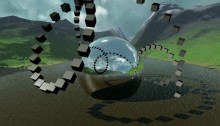
  • Glass and marble head: Yes, the head appears to be floating in the middle of a cathedral of some blurry sort. Click to cycle through different property settings: glass, alien marble (I’m sure that’s a thing), and plain marble.
  • Water surface: Using an animated normal map to illustrate how water could be rendered while using the fake refraction. It also shows the WaterMap util.

Another word of warning: slight implementation details might change in the next few days/weeks, but it should be nothing too dramatic!

I’ll probably be doing something more with this when I have the time, but nothing that would likely make it to the repository :-)

Leave a comment (9 comments)

A heartbeat, some books, and an IDE

Tags: , , , , , , , ,

Ouch! My last post has almost been 5 months ago! Realizing this, I had two options: to feign my own death until the next update, or to give some sign of (what for me passes as) life. Let’s go with the second option and see if there’s anything useful I can pass on anyway.

Not having posted in such a long time doesn’t mean I’ve been slacking off, though. Quite the contrary; the past months have seen some of the most intense coding sessions I’ve went through in a long time. First a 3-month non-stop coding spree for Away3D, followed by continued development on Farbe. Hopefully, the result of both will be available in the (very?) near future, along with some other updates!

Now, instead of giving you demos or code, here’s some other things to help you develop.

(and no, I won’t be sharing any thoughts on the future of Flash)

Books!

Books form such an important part of my development process and knowledge, I’m a bit surprised myself that I haven’t really shared any titles here. Trying to ammend the situation, here’s some of the more influential ones I’ve read since I’ve started this blog (leaving out more general ones concerning design patterns etc):

  • The Pragmatic Programmer, by Andrew Hunt and David Thomas: it’s a classic, and you should already have read it. So why am I still listing it? Because it often seems many Flash platform programmers stick to ActionScript/Flex-related books. Here’s a book that changes the way you think about your code, be it in form of design principles, tools or workflow. It’s a rather short read, so no excuses!
  • Elements of Programming,  by Alexander Stepanov and Paul McJones: I found this one on a random trip to the bookstore. Approaching algorithms and data structures in a very formal and mathematical way, it forces you to – again - think differently about your code, but on a lower level (mainly concerning algorithms using data structures). What I love about this type of books is that you suddenly realize how differently you start tackling certain algorithmic problems. Perhaps not a book for everyone, but an interesting read nonetheless.
  • 3D Game Engine Design, by David H. Eberly: (Thanks to Ralph for suggesting it way back :) ). “The Morgan Kaufmann Series in Interactive 3D Technology” has quite a few good books, but to me, this is the most valuable. Of all books I had at the time, this one taught me most about many 3D engine concepts. During the development of Wick3d, I couldn’t do without it.

IDE – IntelliJ

I’ve recently started using IntelliJ IDEA 9 for ActionScript and Flex development, after hearing Joa and the Flash Bum raving about it. Coming from Eclipse (Flex Builder and FDT), it took a while to get used to, but now I have I can’t imagine returning to Eclipse at all. I have been raving about it in real life, much to the annoyance of my co-workers, so it would be wrong of me not to mention it here.  The refactoring, template and code generation support is simply unmatched, there’s a very useful and clean UML diagram view, properly integrated Maven support, … AND I get to annoy the Java/back-end team directly inside the IDE ;-)

To think I was once had to code C in MS-Dos Edit, how times have changed… :)

Edit: The Flashbum just wrote an article on InsideRIA about how to get started. Read all about it!

That’s about it. I hope this sign of life is useful to anyone after all! If not, I promise there will be more real updates soon!

Leave a comment (5 comments)

All new normal map shaders in Away3D with Pixel Bender!

Tags: , , , , , , , , , , , , , ,

pixelshadingIt’s no secret that I like graphics. It’s the main reason why I play video games and it’s the main reason I got into programming. So obviously I was delighted to be invited and to join to the Away3D team last month. Inspired by my earlier Stok3d project (now on the backburner for a bit), I set off to create similar normal mapped pixel shaders, this time in full 3D. After some rough first patches (Stok3d was pretty simple since it only used DisplayObjects, flat planes), things have luckily shaped up, leading up to the first release!

The current state is a dot-release (3.4.2), so the exact implementation might still change while we’re working towards a shiny new 3.5.

The new shaders

So what is the difference with the previous shaders? Using Pixel Bender, the shading is calculated for every pixel in the texture, resulting in much more detailed and realistic lighting or reflections. Each shader requires an object-space normal map, which you can use to add detailed shading information without increasing the polycount of the mesh.

headshader

The shaders come in three flavors: environment map shaders, and single- and multi-pass shaders. Single-pass shaders take one PointLight3D and any AmbientLight3D on the scene to calculate the lighting, whereas multi-pass takes any number of lights of any type (AmbientLight3D, DirectionalLight3D, and AmbientLight3D). Important to note, tho, is that every light adds another pass and will be slower. Of course, if you’re only using 1 light, always use single pass.

Check out the following classes in Google Code:

  • DiffusePBMaterial: Single-pass, adds diffuse lighting to the texture
  • PhongPBMaterial: Single-pass, adds diffuse lighting and specular highlights, with support for specular maps
  • SpecularPBMaterial: Single-pass, adds only highlights – can be used in combination with Prefab3D‘s prebaked lighting to create view-dependent specular highlights
  • DiffuseMultiPassMaterial: Diffuse shading with multiple light sources
  • PhongMultiPassMaterial: Phong shading with multiple light sources

Demosplaneshader

Enough explanations, time for some demos! Right-click to view source:

That’s it, enjoy! Feel free to drop by the mailing list for questions or read the official announcement! For now, I need to get some sleep before Flash on the Beach kicks off :)

Leave a comment (10 comments)

Cloth simulation modifier in AS3Dmod

Tags: , , , , , , , , ,


flagI was recently invited to create a cloth modifier for AS3Dmod by Bartek Drozdz, similar to the 2D version I did earlier. In the unlikely case you haven’t heard about it before, AS3Dmod is a cool modifier library compatible with the most popular 3D Acionscript engines (Papervision3D, Away3D, Sandy and Alternativa3D). To put it simply, it takes existing 3d meshes and changes its shape on a per-vertex basis, and also allows you to animate them without needing an animated model. Lucky for me, as I was interested in doing a 3D version, and this was the perfect setup to do it in :)
 
The cloth modifier provides some methods and functions to adjust its behaviour (rigidity, air friction) as well as to apply external forces such as gravity or wind. You can also set boundaries to act as fake walls or floors. This modifier works best with meshes that have a flat edge, such as planes, boxes/cubes, cylinders, … This so they can be locked in place at an edge and actually give you something to look at instead of having a mesh that gets blown out of the view straight away :)
One last remark is that the cloth should be the first in the modifier stack. It needs its previous state, and any prior modifiers changing its state will not have any effect.
 
On to the demos!
  • Flag sim with parameters to play with (Papervision3D, 600 triangles): Demo | Source
  • Hanging cloth with fake floor and wind (Away3D, 450 triangles): Demo | Source
  • Strange cube being blown about (Away3D, 1200 triangles): Demo | Source
Get AS3Dmod on Google Code.
Leave a comment (13 comments)

HDR Lighting in FP10 (+ Away3D)

Tags: , , , , , , ,

hdrIf you’ve played any video games the past few years, you’ve definately seen the HDR (High Dynamic Range) effect. Creating a more brilliant colour spectrum, it’s both popular in photography and 3D rendering. In games it typically enhances the brighter areas and makes light spill over into darker areas (the so called light blooming effect). Using some settings, it can also create a more blurry atmospheric surrounding. Being a big game fan (or rather gfx-fetishist), it’s an effect I’ve always wanted to do. Using a tiny Pixel Bender kernel and some Flash filters, I came up with this.

A demo showing the effect and its parameters on a simple image can be seen here: Demo | Source .

But let’s face it, when doing HDR, we want it in 3D ;)  Rob Bateman kindly gave me permission to use his shader demo for Away3D (a 3D engine I’m growing more and more fond of). This demo in particular suited the use of HDR perfectly, so many thanks! I just added the HDRContainer class to the stage, setting the View3D as the target, and voila!

See HDR in Away3D (compare with the original to see the difference)

No source for that one tho, as 1) it’s not my demo (apart from 2 extra lines of code), and 2) it’s pretty much the same as the first demo :)

It should be similar to use the effect on any DisplayObject, for that matter: pass it through to the HDRContainer’s constructor and add the HDRContainer to the stage.

Leave a comment (21 comments)

© 2009 Der Schmale – David Lenaerts’s blog. All Rights Reserved.

This blog is powered by Wordpress and Magatheme by Bryan Helmig.